
Tag Archives: tasting
Tasting Notes from the Cellar

There are lots of ways to put together a collection of older wines. Collect and store them in a cellar, buy them from a reputable merchant who has stored them, steal them from a friend, find a store that has found a so-called library release of wines aged at the winery, et cetera. Each of these methods (Except stealing. I think.) were put to use a couple weeks back when a group of us got together to drank some older wines.
A few notes, recorded for posterity’s sake…
1979 Roagna Barbaresco
Delicious from the start, this might have been my favorite wine of the evening, opening up to a beautifully tart and fruity wine with very noticeable spicy and herbal undertones. Tarragon? Mint? Tobacco? Umami? A really nuanced wine that moved from being a bit tannic to downright light and lively. As Todd said, the “most complete wine” of the evening.
1989 Beaucastel, Chateauneuf de Pape
Earthy and big to start, it finished with an edge that smoothed out and opened up over time. A little funk early on that blew off quickly. Lots of fruit, though, even from the onset. Steve observed it might be on the downside of its life. But after a couple of hours, the leather and tannin subsided a bit. Pretty classic; a fine drink.
1999 Antoine Arena, Patrimonio
Dark, deeply colored, full of sediment, brooding aromas to start. Dirty, tannic, earthy wine. Some minerality and acid. Looks brooding, full of flavor, but surprisingly youthful. I wish I’d taken more detailed notes, but the general sentiment was that this was in a good place. Steve observed in retrospect that it was hard to wrap his head around this, and I agree: It was the biggest of the all and came late in a long night of drinking.
1990 Bongran Macon Clesse
 Remarkably unique. Truly. Drew a chorus of quizzical looks and comments. Todd described the aromatics as being a lot like coffee beans, and Putnam began to latch onto that as a descriptor for the flavor as well. I think I see what they were getting at in terms of a the long, slow, earthy quality of the fruit. Floral and honey notes. Not sweet but clearly botrytized grapes. Lots of tropical fruit but not of the predictable sort found in so many overly engineered wines. Some in the group felt it would be hard to drink this in any serious quantities, me among them, but it’s hard to deny its brilliance.
1996 Dugat-Py Bourgogne Rouge
I wonder what this cost on release. No famed crus on the label. Just good wine in the bottle that has lasted until now. Light, refreshing, but still structured. As Putt said, it’s “chuggable.” Of course, Putt thinks whiskey is “chuggable.” But still, I tend to agree. We also had a 1995 Marechal Pommard, and the Dugat-Py was in a far better place. The other was gnarled and dare I say backward whereas this was simply pretty.
1999 Juge Cuvee C Cornas
Coming after a puckeringly tart Morgon and even the Chateauneuf, this was downright jammy. Young and fruity. A nice dose of acid, but compared to other wines, this really seemed sweet. Delicious but didn’t really suck me in the way some others did.

Drinking 2009 Jaboulet
Since the early 19th Century, Paul Jaboulet Aîné has been rocking folk’s taste buds with wine produced in France’s Rhône Valley. If you’ve ever browsed the French section of a wine store you’ve likely seen their Côtes du Rhône Parallèle 45, an entry-level southern Rhône blend of Grenache and Syrah.
But they built their reputation through parcels in the northern Rhône, Hermitage La Chapelle being the most famous. The 1961 vintage of Hermitage La Chapelle has achieved an almost mythical status among the wine cognoscenti (only $12k/bottle for those of you with a little extra disposable income).

Things weren’t as bright for Jaboulet through the 90s and into the new century. Production was up but quality was patchy. In 2006, the Frey family (proprietors of Chateau La Lagune in Bordeaux) purchased Jaboulet and applied sweeping changes that included a stricter selection process and significantly lower yields.
This is all just the long way of saying we hung out at Café Muse the other day and drank some 2009 Jaboulet with Elie. It was tasty.
My notes:
Châteauneuf du Pape “Domaine de Terre Ferme”
We started with the one southern Rhone in the bunch. Aromas of purple jelly led into wood smoke. Full body across the palate finishes long and herbal. This wine wanted to arm wrestle with me but I declined.
Côte Rôtie “Domaine des Pierrelles”
An elegant wine. On the nose there’s an initial hit of buttered toast and fruit compote that morphs into cedar and then flowers and then other lovely things our ancestors would know better than us. It somehow balances heft and grace like a ballerina that throws shot put as a hobby. All of the wines had plenty of acidity but it shone brilliant in this one, long and juicy. I’m writing this note a week later and I still get all tingly just thinking about it.
St. Joseph “Domaine de la Croix des vignes”
Fat with aromas of ripe fruit. Balanced across the center. There is weight here and also a long and dry finish sprinkled with powdery tannin.
Cornas “Domaine St. Pierre”
Immense nose of crushed berries and meat. Once you make it past the massive tannins a long and happy acidity shows. The provided tasting notes mention that you might want to cellar this monster for at least a decade before drinking. I believe those notes.
Crozes Hermitage “Domaine de Roure Rouge”
Heady aromas of stones, river banks, flowers, cedar closets, etc…all swirly and turning into steamed fruit and everything else. Fat, almost sweet through the middle yet finishes with a lively acidity. I can’t get my nose out the glass and I even save a bit for later sniffing.
Hermitage “La Petite Chapelle”
Nothing small about it. A dense and succulent drink of wine beneath scents of black currant liqueur and herbs.
Hermitage “La Chapelle”
If I counted off the aromas and flavors it would read like a French country village market shopping list including a side of beef. It is said that this wine will age 50 years. Grab a case and you might make your grandkids rich.

A Pleasure So Exquisite

Blogging about eating or drinking some really exquisite, rare treat always feels funny to me. Mostly, I like to do it for the sake of aiding my memory, generally enfeebled by bourbon-pickled brain cells. And I like reading other people’s tasting notes too. But conversely, it feels a bit like bragging, which kind of sucks.
Despite that, I just had to write last night’s tasting notes down, both for posterity’s sake and for sharing. It’s a rare opportunity (for me, anyhow) to sit down with three good friends and drink five bottles of aged Bordeaux in great condition. Such an occasion requires some documenting, even if as the writer I’m the only one who ever bothers to read it.
We gathered in a cleaned out (sort of), empty cinder block building in Detroit, four of us with five wines, a small folding table, and a few chairs.
1979 Haut-Bages Liberal (Paulliac)
There are sensations, some hard to describe, unique to older wines. Initially quite musty, damp, and funky, the aromatics on this wine gave way to a lot more lively fruit. From the onset, it tasted fresh and alive with some grippy tannin in the finish; but as the evening wore on and we re-visited the wine two more times, light, fleshy fruit flavors dominated with a really bright, youthful acidity. Delightful stuff.
 1978 Prieure-Lichine (Margaux)
Aromatically challenged to start, this might have evolved the most over the course of the evening. Early on, there was just a bit of soft fruit on the nose. Eventually, it became noticeably more menacing (in an exciting way) with darker, woodier notes. Tasted perfectly fine from the get go, albeit with a bit of a vegetal finish, but it got considerably more nuanced, meaty, and leathery as the evening wore on with a much more focused, almost minty quality at the end of each sip.
1981 Palmer (Margaux)
Steve commented during our first glass of this that he thought 1981 was a bit underrated, and based on our limited evidence, I think we all agreed. There was a big, distinctive cabernet sauvignon nose with just a bit of a gnarly, rustic edge to it. Immediately captivating. Definitely the weightiest, fullest, richest of our three oldest wines. Quite tannic but still fruity, acidic, and ripe. Killer wine worthy of the venerable name (and totally bad ass label).
1998 Gruaud Larose (St. Julien)
Disclaimer: I love this producer. It’s rustic, edgy, and funky, and I think it’s magnificent. I’ve had the good fortune of tasting some great vintages of this wine, and it’s never disappointed me. This was no exception. Dense and still young, though not so wound up as to seem premature to have opened it. As the evening wore on, the aroma showed more juicy, grapey, dark fruit qualities and finished with a sharp, savory characteristic.
1996 Leoville-Poyferré (St. Julien)
In a word, this was INTENSE. Still too young. All coiled up and restrained, just about ready to explode. This is on its way up to a glorious place. Toasty, woody aromatics. Soft tannins. Dark fruit and lively finish but still reserved. This just envelopes one’s entire palate and finishes with a subtle stony edge. It’s a big wine, but it was still quite elegant. Great drinking now, even better later.
I’d discussed with Steve in the past how it seems like there are just certain nights when everything clicks. This was one of those nights: Five older wines, each one alive and entirely spot on. We should have hit the casinos afterwards. (But instead we had beer, a decision with which I have no argument.)
Cellared wines are an entirely different beast from what’s typically available in the store, and despite the pretentiousness one could quite easily read into the cost and/or effort involved in drinking aged wines, anyone who were to spend time with bottles like these would comprehend and possibly participate in the obsession. A perfect night.

Three Gamays
A week or so ago, I swung into Everyday Wines in Ann Arbor. Jackie pointed out some new wines, including a few of her favorites. I decided to select a few gamays that she and Mary were enjoying. Some tasting notes:
2006 Cote de Brouilly, Domaine de Robert Perroud – Smells like flowers, spice cake, cola, and dried cherry. I’d think at first whiff that it was destined to be sweet and luscious. And it begins to hint at those ripe, fruit forward flavors. But there’s some serious grip to this wine, even after a few years of bottle age. The finish doesn’t linger, but there’s depth here. Lots of pretty layers to this.
2009 St. Pourcain, Chambre d’Edouard, Domaine Grosbot-Barbara – Light and fun, there’s that quintessential stony nose characteristic of so many Loire wines. This is obviously a brighter wine, though, with less “rocks” and more pure fruit. A Pinot Noir/Gamay blend that’s dominated by the former, this is the most delicate and playful of the three wines I’m trying. Tart cherry, berries, and flowers. A real value in the neighborhood of 15 bucks.
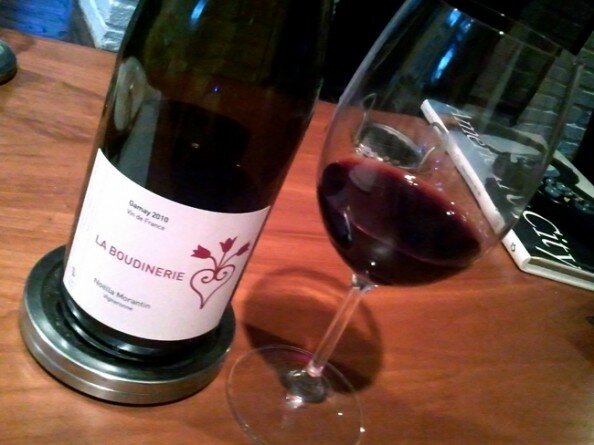
2010 Gamay La Boudinerie, Noëlla Morantin – This wine can be a bit of a head scratcher at first. On one hand, this strikes me as being very similar to any number of dirty, rustic Loire Valley gamays, most notably from the Touraine appellation. On the other hand, this does have some interesting qualities. And in reading up on Morantin’s wines, it looks like she does indeed work in that region and is located near the sites of some of my favorite Loire gamays. So this is in many respects the essence of natural wine reflecting terroir: the natural yeast, the soil, the grapes, the weather should all be similar to these other wines. With minimal manipulation, it’s unsurprising that there are so many features similar to other wines I love. So what this may lack in distinctiveness relative to other “natural” gamays from the region, it makes up for in enjoyment and expression of a place and an ideal. All that bullshit aside… There are grape undertones to an otherwise earthy nose. Mildly herbal, there are mostly berry flavors here and a bit of astringency and acidity at the finish. Opens up quite a bit over a half hour. While this strikes me as a bit dull and earthy, it’s fundamentally nice stuff with a rustic yet feminine quality.
Some of these, notably the Morantin, are available elsewhere, but if you’re in A2, stop in and see Mary, Jackie, or Putnam at Everyday Wines in Kerrytown!
Rye Tasting
Distilling rye has a history in America that extends back into the 1700s, a practice that was regularly undertaken by eastern settlers with surplus grain. George Washington was even among those who made whiskey from his rye, a fact which certainly must qualify it as one of our country’s classic spirits. Hence, Gourmet Underground Detroit felt it was our duty as Americans to taste through an assortment of this chronicled beverage.
Equal parts stout patriot and mad genius, my dear friend John thus organized a small group of folks — he and I were joined by Karla and Noah — to gather at his apartment in Northville to taste through a half dozen rye whiskeys.
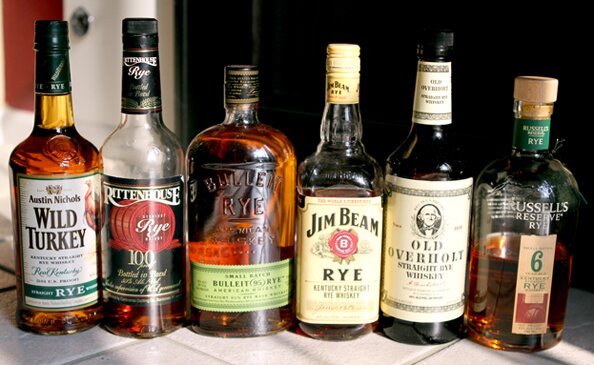
Unfortunately, Sazerac brand rye, which is generally one of the commonly available ryes in Michigan, is in short supply at the moment, or so we were told by several store clerks in western Wayne County. But we had the other notable state-sanctioned products — Jim Beam, Wild Turkey, Russell’s, and Bulleit — as well as two ryes that are among the most popular across the counry in the form of Old Overholt and Rittenhouse 100.
None of these are terribly expensive, and we intentionally ignored products like the $200 aged Rittenhouse product or the “Ri” whiskey from Jim Beam, which at $40+ on the retail shelf isn’t something with which most people would be interested in mixing.
Setting aside our observations and opinions for a couple of paragraphs, it’s worth mentioning a few basic facts about rye, especially considering that it has a pretty limited following in the metro Detroit area.
Whiskey of all sorts is essentially just a distillation of a rudimentary beer. Most whiskey we drink has been aged in barrels for some length of time. Bourbon, arguably the more familiar whiskey to most Americans and certainly to most Detroiters, contains at least 51% corn in that grain mixture. Rye, by contrast and by law, must contain at least 51% rye. The remainder of the grain bill can be just about anything, though in the case of rye whiskey, those grains are generally corn, wheat, and/or malted rye.
Maryland, Pennsylvania, New York, and Virginia were all states noted for their rye traditions, with unique characteristics ascribed to each. After WWII, many of the notable bottlers were bought up and shut down or sold again, and those that stayed open were gobbled up by larger companies. Indeed, Pikesville, a perfectly pleasant drink with a nice fruity nose and smooth flavor, is a whiskey long associated with Maryland. But it’s now manufactured in Kentucky, “rescued” by Heaven Hill distilleries. The same applies to Rittenhouse, a brand in our tasting that represents Pennsylvania rye.
Indeed, as with most spirits, the landscape changed considerably after Prohibition. Bourbon gained favor with whiskey drinkers, and vodka seemed to catch on with everyone else.
Fortunately, we’re in the midst of something of a rye renaissance. In addition to the large-scale products that are enjoyable – like Rittenhouse or Overholt – producers like Tuthilltown, Anchor, and Whistlepig are creating new, smaller batch products that seem to be catching on for drinking straight or use in particularly high end cocktails.
In that spirit of renewal, here are our notes from the tasting. We drank the whiskeys blind, and the notes below are presented in the order in which the ryes were consumed.
Jim Beam Rye
The initial reaction from the entire crowd was that the whiskey didn’t taste like much of anything. There’s a slight sweetness with just a bit of vanilla barrel flavor and a mild spiciness. Very mild body. But beyond that, the Beam was inoffensive enough to be passable for cocktails but rather uninspiring otherwise.
 Russell’s Reserve 6
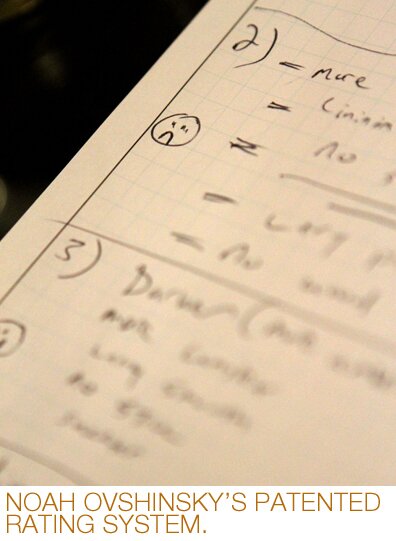
As Noah immediately mentioned, this was lighter in color than our first blind entry: Russell’s 6-year was more of a yellow-ish color than most whiskey. Aromatically, this was simply weak – not much there. On the palate, it was so bland as to be insipid. Karla didn’t get past two sips before passing hers off. There was barely a spiciness to it, something that one commonly expects in a rye, and it ended with a strange bitterness that, while mild, was off-putting. I’ve mixed Russell’s in plenty of drinks and not been too upset about it, but in this naked setting, it was clearly outmatched.
Bulleit Rye
Standing in stark contrast to the first two, this screamed with unique flavors and smelled of honey and herbs. I was somewhat alone in thinking that it had a thyme-ish quality in the nose. The spiciness was prickly but only accompanied by the most mild alcohol burn, and a light honey sweetness with a bit of toffee bitterness in the finish continued throughout the drink. It lasts a long while with that herbal, woody, toffee flavor making for a fairly savory rye. Of course, rye is the grain responsible for those flavors and for spice, so it should come as no surprise to newcomers to this product that it contains 95% rye, an unusually high percentage.
Rittenhouse 100
Arguably the most powerful of the ryes, this was obviously a 100 proof whiskey from the get go. In terms of complexity, it suffered coming immediately after the Bulleit. But as the most potent beverage in the tasting, spiciness and booze shone through with a mild, grassy finish. This is a clean, edgy whiskey that manages to be quite dry and full at the same time.
Old Overholt
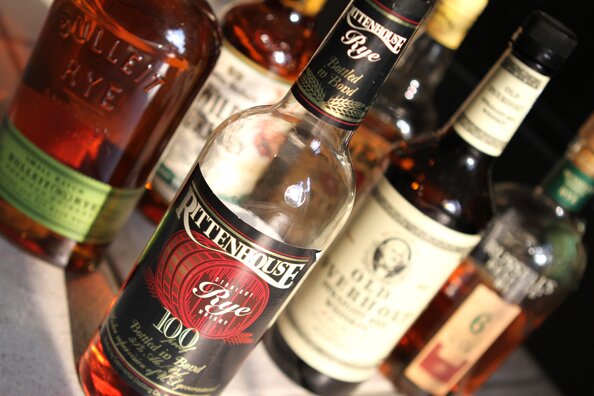
Sort of a middling option from the first whiff, this had a bit of spice, a bit of sweetness, a bit of vanilla, and a bit of maple on the nose and honey on the palate. Lower in alcohol, it was immediately characterized as being rounder and while not widely rejected by our group, it wasn’t beloved either. Of course, this is still a value: It’s less than 15 bucks just about anywhere you can find it (not in Detroit), and in a pinch, it gets the job done. In the price range, it’s clearly a better option than Beam.
Wild Turkey
This is the most well-rounded whiskey. It had some body and some mild spice, but despite its higher proof, it’s not at all hot. And however it’s aged, it results in a pleasant, mild vanilla flavor. This whiskey also ranked highly with everyone, and considering the price and the fact it’s readily available in Michigan, it would arguably be our “go to” rye in the state.
* * * * * *
The Manhattan Project
Drinking straight whiskey is fun. No one would deny that. But in the interest of scientific exploration, we elected to make some Manhattans with the top three ryes from the tasting. If it wasn’t obvious from the notes, we chose to use Bulleit, Rittenhouse, and Wild Turkey.
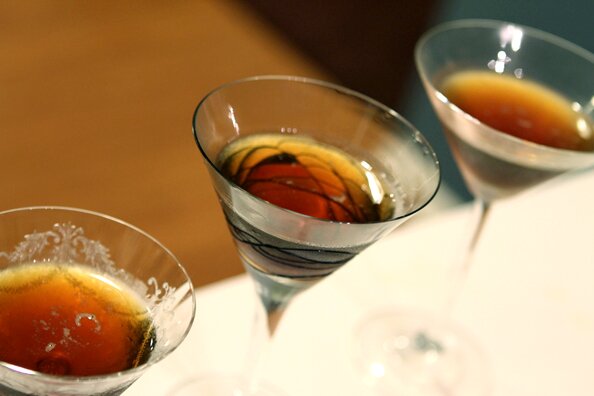
John and Noah preferred the Bulleit best, whereas Karla preferred the Wild Turkey, and I preferred the Rittenhouse. The Bulleit certainly had a lot of flavors going on, though in my mind, it clashed a bit, adding a spicy smoke flavor to a drink that might not best carry those particular sensations. What one man considers complex might be another man’s confused, and vice versa. Wild Turkey carried its round, pleasant qualities through to the Manhattan and blended seamlessly. Rittenhouse created, for me, the most interesting drink: pleasant but not simple, complex but not awkward, spicy but not hot.
A certain someone hosting the tasting disagreed with my assessment and offered this unkind gesture:

It’s hard to lose with any of these three whiskeys — either for drinking straight or for drinking in a cocktail — but for Michiganders not looking to ship from out of state, Wild Turkey is the clear winner.
An Epiphany: Maison Surrenne
Several months ago, I was privileged enough to have a friend serve our dinner party a glass of a cognac with some lengthy barrel aging. I didn’t have much context for cognac: Other than Hennessey or Courvoisier, I’d never really had any French brandy. That first drink didn’t haunt me in continuous fashion the way my first glass of Talisker scotch did, but it definitely lingered in my mind, surfacing every month or so. It was enjoyable and unique. I thought I finally decided to do something about it.
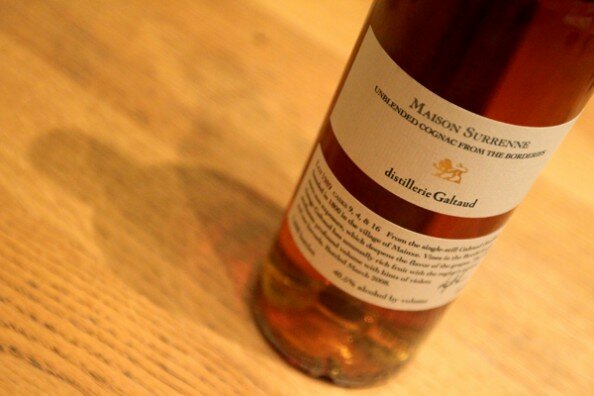
Maison Surrenne is a large distillery, boasting eight cellars of brandy covering multiple regions of Cognac. I’d be lying if I understood the organizational structure and how the family history ties into the business and the region, but it’s worth noting that this bottler is apparently still family owned.
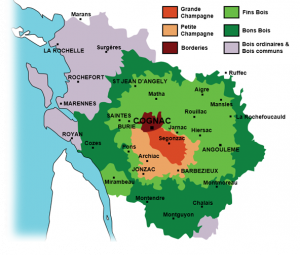 My first purchase was their unblended Borderies cognac, with Borderies being the specific sub-region from which the spirit came. Into my second glass, I can’t disagree with the notes offered on the bottle’s own label: Vines in the Borderies get more sun exposure, which deepens the flavor of the grapes. The single-vintage Galtaud has unusually rich fruit with the region’s typical attributes: profound volume with hints of violets and nut kernels.
Galtaud is the single-still distillery, founded in 1800, at which this cognac was produced. This particular bottling is listed as “Lot 1989: Casks 9, 4 & 16.” One of 1600 bottles produced, this is 40.5% alcohol by volume and was bottled in 2008. According to the Maison Surrenne website, the Borderies region is known for its rich soil deposited in years long past by the nearby Charente River.
This is all new to me, but you can certainly taste that richness and depth: Maison Surrenne is delicious stuff. It absolutely smells like violet, toffee (or perhaps nut kernels, a descriptor with which I’m unfamiliar), and even caramel. And on the palate, the floral, violent sensation absolutely hits me over the head. It’s incredibly noticeable, though refined and elegant. The finish is hot, spicy, and alcoholic, but it’s violet again and cocoa nibs that linger for me. There’s a moderate orange/apricot sensation somewhere in there that I can’t quite pinpoint. This isn’t a sweet spirit, but it certainly has a sweetness to it derived from the fruity and nutty qualities. Despite even that, it’s got a long, hot, dry finish full of flowers and alcoholic spice. How can anyone not love such a thing?
Regardless of what wine media-driven adjectives I could possibly ascribe, the bottom line is that this is one classy spirit. For the first time ever, I understand why the stereotypical wealthy baron of cinema asks people to retire to the study for some cognac or other brandy. This is good drinking. Great drinking.
Cognac at this level is, for me, a revelation. Further study is required, and I’ll be working a lot of extra hours to (happily) pay for that self-imposed research.
Neither Rain, Nor Snow, Nor Sleet: Wine Lovers Shall Not Be Deterred
Wine can make people do crazy things: spend too much money, consume too much alcohol, or in the case of me and some friends, drive 35 miles in a blizzard that ultimately produced 10+ inches of snow. Of course, these weren’t just any wines. Nine-dollar bottles of Grenache aren’t worth spin outs and 90-minute car rides.
No, these were older wines.

Properly stored, old wine offers a unique and wonderful experience. And while writing about that wonderful experience on a blog is inherently self-indulgent – outright braggotry, really – it’s also a chance to explore one of those aspects of wine that can be intimidating and seem out of reach. Perhaps more importantly, it’s an opportunity to provide some much-needed context for the mythos and aura of inscrutability that seems to surround cellared wines.
Among all the supermarket wines that have immense popularity among broad audiences and among many of the lighter, so-called natural wines that have justifiably obtained a cult-like status with many aficionados, one thing that’s often missing is the potential for aging – that is, an intense structure of tightly coiled flavors that can unfurl into unparalleled elegance over time.
So when our good friends Steve and Robin invited a number of us over to open some cellared bottles (mostly Steve’s), neither snow, nor rain, nor gloom of night could have deterred us from that enjoyment.
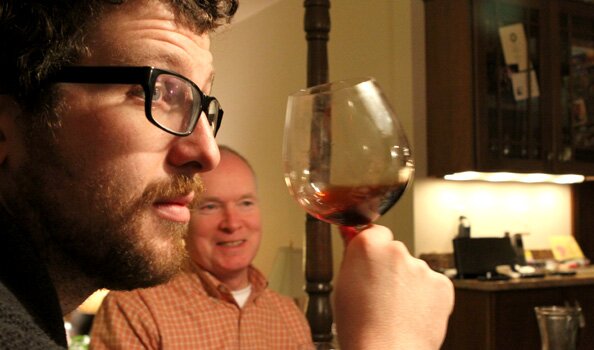
The line up, in the order we tasted them:
1999 Drouhin – Volnay, 1er Cru, Clos des Chenes
You know that your day is off to a good start when you’ve “warmed up” on Farnum Hill hard cider and your first act is a burgundy with ten years of age on it. Notably floral on the nose with some hints of berry. Nicely structured with surprising tannin for such a lightly colored wine.
1985 Breton – Bourgeil, Les Perrieres
While not the most electrifying wine of the night, this cabernet franc from the Loire Valley proves to be quite illustrative of the concept of what happens to nicely structured, well made wine as it ages. Many younger bottles of this wine are delicious but are so heavy with astringency from tannins and with flavors of tar that it can be a chore for newcomers to cab franc to enjoy it. Over time, though, this wine hasn’t lost any of its oomph, but the tannins have relaxed a bit. There’s a spicy, poignant quality to the finish and a lot of very bright fruit flavors up front. This would have tasted much different in 1988 than it does today. I’d guess it would have been more like a knife on the palate – hard and sharp – than so broad and flavorful. Delicious either way but truly elegant later in life.
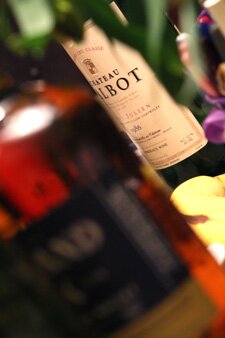
1986 Chateau Talbot – St. Julien
Great Lakes roastmaster James Cadariu and his finely honed olfactory senses immediately noticed that “this wine smells like poop. But,” as he went on to explain, “in a good way.” It definitely begins with a very dirty, very barnyard, very fecal nose. Brettanomyces, perhaps? In terms of flavor, however, any hint of that flaw is gone. Instead, it’s elegant and layered with chocolatey black fruit and smoke. Nicely balanced with acidity. There’s still some tannic structure, but a lot of it has faded to let that delicate fruit flavor through.
2001 Voge – Cornas, Vielles Vignes
Pours with just the slightest purple hue, and the aromatics are quite expressive. Berries and flowers hint at what’s to come: While there’s still plenty of tannin and some pepper, it’s fundamentally a feminine and pretty wine.
1988 Fattoria dei Barbi – Brunello di Montalcino
Wines can sit too long, of course. While they can develop complexity, the various reactions taking place inside the bottle can also free up sugars or create off flavors or aromas. I’m not precisely sure what happened to this Brunello, but it tasted like brown sugar and had a very syrupy mouthfeel despite its age. It had a funny, herbal nose, and while it was drinkable, the only descriptor I can come up with is “strange.” This certainly illustrates two of the common myths with cellaring wine – that any red wine will get better with age and that wines can age indefinitely. It’s a living thing that evolves in the bottle. The number of years of age matter, but so does the original juice put into the bottle, itself a product of climate, technique, and the blend of grapes. Wines have a peak, and this wine was looking at its peak in the rear view mirror.
1970 Cappellano – Barolo, Serralunga d’Alba
I might be biased since I brought this to the party, but this was one of my favorite wines of the night. Aromatically complex, this wasn’t nearly so fecal as the 86 Ch. Talbot, but it definitely carried a funk to it that smelled to me like decomposing grass clippings and some funky cheese. That lessened as the wine opened up, but some element of that aroma was always there. On the palate, though, it was remarkably bright with some pleasant acid and lots of tannic structure left. While it was bone dry, there was still enough fruit to keep it in balance. A very elegant but powerful, masculine set of flavors. Surprisingly, while this was expectedly light and transparent, it was also very much reddish in color. Older red wines tend to develop a brick-ish brown color over time.
1995 Vieux de Telegraphe – La Crau, Chateauneuf de Pape
Another standout in an evening full of them. This is arguably the most pleasing wine of the night aromatically speaking, still showing quite a bit of fruit and pleasant herbal qualities in the nose – fresh coffee, pepper, and just a bit of funk compared to some of the much older wines from earlier. Very spicy and fruity on the palate. These wines can be delicious but very closed down early, but this is at its peak, so to speak, just full of flavor that lingers and surprisingly, almost light on the tongue. This is what happens when top flight producers with good grapes make wine that doesn’t force wine media-approved blackberry flavor down your throat.
1997 Luciano Sandrone – Barolo, Cannubi Boschis
While this event wasn’t really planned to be an illustration in the various aspects of older wines, nor a showdown between classic winemaking and modern winemaking, it has certainly turned out that way. This Barolo is from a storied property, but you’d never know it was Barolo. While it’s not poorly made, it only tastes like berries and oak (more specifically, it tastes like vanilla and lotion). It may shed some of the obvious vanilla flavor over time, but this will never show that kind of elegance we saw in earlier wines.
1976 JJ Christoffel – Urziger Wurzgarten, Trockenberenauslese
In contrast to red wines, which get lighter as sediment falls out of the wine, whites get browner and darker as they age. And instead of tannins helping to preserve the wine and breaking down to provide flavor, the high sugar and acid content in Rieslings like this tend to be the preservative element that lets them age so well. And this is a perfect illustration of both: It pours a dark brown, caramel color, a stark contrast to the highlighter yellow of a younger wine, and it is holding up very well. Tastes like toffee and tart mixed fruit jam. Very sweet but still in balance and drinkable. This isn’t a dessert wine; it’s dessert, period.
* * * * *
Wines made for keeping aren’t inherently better than other bottles, but they’re unquestionably different. Tasting notes, no matter how descriptive, can’t really convey the nuance and elegance of properly stored, cellared wines. And a single blogger living on the outskirts of Detroit with a modest history with aged wine can’t possibly do them justice.
But hopefully, he can convince you they’re worth seeking out.
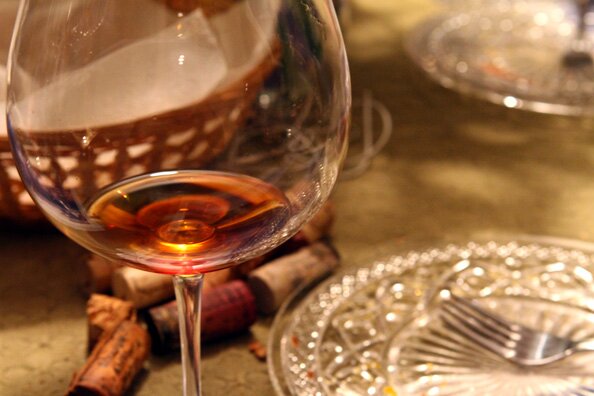
Without a cool, dark space with relatively consistent temperature in which to store wines for 5, 10, 20 years – or more importantly, without the patience to wait that long – the only way to try old wines is to buy them from a trusted retailer that specializes in holding on to bottles, buying other people’s cellars, or buying up library releases (i.e., when a winery sells older stock that it has kept at the winery for aging).
Locally, our choices are limited. I’m sure that there are other stores of which I’m not aware, but a Detroiter’s best bet is to stop in and see Elie in Royal Oak or perhaps to ask another retailer to special order something if you have knowledge of a library release coming to town. I know that both Western Market in Ferndale and Cloverleaf in Royal Oak have purchased one or two older vintages of Rieslings in years past.
Alternatively, hit the Internet. Places like Cellar Raiders and Chambers Street Wine have a good track record of finding properly stored wines and selling them off. A good retailer will probably offer suggestions or tasting notes – Chambers often does – but if one is uncertain as to a particular vintage or producer, an hour or so of poking around Google will reveal a lot of the information one could need to get started.
Cost becomes a factor for buying cellared wines or library releases, of course. But these aren’t daily drinkers, and the way I’ve hurdled the expense barrier is to (a) only buy a tiny number of these per year, (b) do research, wait patiently, and buy very selectively, and (c) start a tiny side business that gives me a little leeway to blow on a $100 or $125 bottle. Any or all of these are a good way to avoid timidly asking your local bank for a wine mortgage.
Finally, if you’re really desperate to try some older wines and don’t have a penny to your name, you could always come to the next Gourmet Underground Detroit event, hope Steve shows up, and suck up to him. He likes good food, wine, and scotch. And he accepts gifts.

